
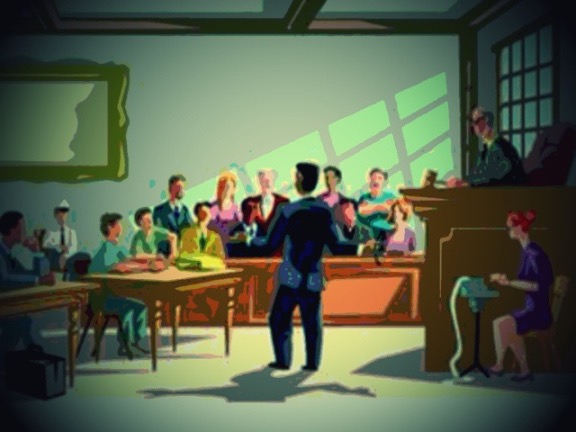
 Bushel’s case is the famous English decision which established the right of the jury to render its verdict free of harassment and retaliation from the bench. In that case William Penn was wrongfully prosecuted for leading and engaging in a peaceful assembly of citizens to hear his speech for religious freedom. Nothing unlawful occurred but Penn was none the less prosecuted and represented himself. The jury refused to find him responsible for inciting a riot. The judge appalled by the jury’s verdict ordered them to return a verdict of guilty and held them over without food or water. After several go arounds the jury refused to give in to the Court’s bullying. The foreperson announced in open court:
Clerk Are you agreed upon your verdict?
Jury. Yes.
Clerk. Who shall speak for you ?
Jury. Our Foreman.
Clerk. Look upon the prisoners at the bar; how say you? Is William Penn Guilty of the matter whereof he stands indicted in manner and form, or Not Guilty?
Foreman. Guilty of speaking in Grace-church street.
Court. Is that all ?
Foreman. That is all I have in commission.
Rec. You had as good say nothing.
May. Was it not an unlawful assembly? You mean he was speaking to a tumult of. people there?
Foreman. My Lord, This is all I had in commission.
This was not the end:
Obser. Here some of the jury seemed to buckle to the questions of the Court: upon which, Bushel, Hammond, and some others, opposed themselves, and said, they allowed of no such word as an unlawful assembly in their Verdict; at which the Recorder, Mayor, Robinson and Bloodworth took great occasion to vilify them with most opprobrious language; and this verdict not serving their turns, the Recorder expressed himself thus:
Rec. The law of England will not allow you to part till you have given in your Verdict.
Jury. We have given in our Verdict, and we can give in no other.
Rec. Gentlemen, you have not given in your Verdict, and you had its good say nothing; therefore go and consider it once more, that we may make an end of this troublesome business.
Jury. We desire we may have pen, ink, and paper.
Obser. The Court adjourned for half an hour; which being expired, the Court returns, and the Jury not long after.
The Prisoners were brought to the bar, and the Jury’s names called over.
Clerk. Are you agreed of your Verdict?
Jury. Yes.
Clerk. Who shall speak for you?
Jury. Our Foreman.
Clerk. What say you? Look upon the prisoners: Is William Penn Guilty in manner and form, as he stands indicted, or Not Guilty?
Foreman. Here is our Verdict; holding forth a piece of paper to the clerk of the peace, which follows.
‘We the jurors, hereafter named, do find William Penn to be Guilty of speaking or preaching to an assembly, met together in Gracechurch-street, the 14th of August last, 1670, And that William Mead is Not Guilty of the said Indictment.’
Foreman Thomas Veer, Edward Bushel, John Hammond, Henry Henley, Charles Milson, Gregory Walklet, John Baily, William Lever, Henry Michel, John Bnghtman, James Damask, Wil. Plumsted.
Obser. This both Mayor and Recorder resented at so high a rate, that they exceeded the bounds of all reason and civility.
Ultimately, the jury’s prerogative to act free from improper influence was upheld and is still with us today.
Clearly the law empowers a jury to act independently and free from of retaliation. We have Foreperson Bushel to thank for this grand check on the power of government and bullies alike.
 The Right to Trial by Jury