
 Bushel’s case is the famous English decision which established the right of the jury to render its verdict free of harassment and retaliation from the bench. In that case William Penn was wrongfully prosecuted for leading and engaging in a peaceful assembly of citizens to hear his speech for religious freedom. Nothing unlawful occurred but Penn was none the less prosecuted and represented himself. The jury refused to find him responsible for inciting a riot. The judge appalled by the jury’s verdict ordered them to return a verdict of guilty and held them over without food or water. After several go arounds the jury refused to give in to the Court’s bullying. The foreperson announced in open court:
Clerk Are you agreed upon your verdict?
Jury. Yes.
Clerk. Who shall speak for you ?
Jury. Our Foreman.
Clerk. Look upon the prisoners at the bar; how say you? Is William Penn Guilty of the matter whereof he stands indicted in manner and form, or Not Guilty?
Foreman. Guilty of speaking in Grace-church street.
Court. Is that all ?
Foreman. That is all I have in commission.
Rec. You had as good say nothing.
May. Was it not an unlawful assembly? You mean he was speaking to a tumult of. people there?
Foreman. My Lord, This is all I had in commission.
This was not the end:
Obser. Here some of the jury seemed to buckle to the questions of the Court: upon which, Bushel, Hammond, and some others, opposed themselves, and said, they allowed of no such word as an unlawful assembly in their Verdict; at which the Recorder, Mayor, Robinson and Bloodworth took great occasion to vilify them with most opprobrious language; and this verdict not serving their turns, the Recorder expressed himself thus:
Rec. The law of England will not allow you to part till you have given in your Verdict.
Jury. We have given in our Verdict, and we can give in no other.
Rec. Gentlemen, you have not given in your Verdict, and you had its good say nothing; therefore go and consider it once more, that we may make an end of this troublesome business.
Jury. We desire we may have pen, ink, and paper.
Obser. The Court adjourned for half an hour; which being expired, the Court returns, and the Jury not long after.
The Prisoners were brought to the bar, and the Jury’s names called over.
Clerk. Are you agreed of your Verdict?
Jury. Yes.
Clerk. Who shall speak for you?
Jury. Our Foreman.
Clerk. What say you? Look upon the prisoners: Is William Penn Guilty in manner and form, as he stands indicted, or Not Guilty?
Foreman. Here is our Verdict; holding forth a piece of paper to the clerk of the peace, which follows.
‘We the jurors, hereafter named, do find William Penn to be Guilty of speaking or preaching to an assembly, met together in Gracechurch-street, the 14th of August last, 1670, And that William Mead is Not Guilty of the said Indictment.’
Foreman Thomas Veer, Edward Bushel, John Hammond, Henry Henley, Charles Milson, Gregory Walklet, John Baily, William Lever, Henry Michel, John Bnghtman, James Damask, Wil. Plumsted.
Obser. This both Mayor and Recorder resented at so high a rate, that they exceeded the bounds of all reason and civility.
Ultimately, the jury’s prerogative to act free from improper influence was upheld and is still with us today.
Clearly the law empowers a jury to act independently and free from of retaliation. We have Foreperson Bushel to thank for this grand check on the power of government and bullies alike.
Author: Richard A. Cook
Richard Cook graduated from Purdue University in the Economics Honor Program in 1979 and obtained his Juris Doctor degree from Valparaiso University School of Law in 1982. Following law school, Richard served as a federal law clerk in the U.S. District Court for the Northern District of Indiana, Hammond Division. In 1984, Richard began working as Deputy Prosecutor for the Lake County Prosecutor's Office and from there, served as Assistant U. S. Attorney for the Northern District of Indiana, South Bend Division. There he handled a number of complex criminal matters and jury trials. While there, Richard received the Chief Postal Inspector's Special Award and a letter of commendation from the U.S. Attorney General for his work prosecuting a major money order fraud scheme being perpetrated out of the Indiana State Prison system. Since leaving the U.S. Attorney's office in 1989, Richard has focused primarily on civil work and is currently a member of the firm Rich Cook Law in Indianapolis. Richard is also a member of the ITLA, IBA and the ABA, as well as, a fellow for the Indiana College of Trial Lawyers. He is AV rated by Martindale-Hubbell.
I have been called for jury service…. Now what?
THOMAS JEFFERSON (1789): “I consider trial by jury as the only anchor ever yet imagined by man, by which a government can be held to the principles of its constitution.”
My last blog post made me realize that potential jurors need guidance. What is their role? What should they do if called to serve? Jury service is the greatest civic responsibility we have. Our service is necessary, if we want to live in a free democratic society. Citizens have braved criticism, threat of punishment and public ridicule to give their verdict to insure liberty and justice for all.
The right to trial by jury is so important that it is guaranteed twice in the U.S. Constitution under the 6th and 7th Amendments for criminal and civil trials, respectively. Grand jury protection is required for the issuance of criminal charges in federal court under the 5th Amendment to the U.S. Constitution.
Here are some do’s and don’t to keep in mind:
1. In the days leading up to your jury service, don’t read the newspaper or watch television or read the news.
2. Dress like you respect the proceeding and be on time.
3. Accurately and completely answer your jury questionnaire. This is the primary source of information the attorneys will use in deciding if you should serve.
4. Pay close attention to the questions asked by the attorneys during jury selection. Fully and accurately answer the questions asked as someone’s well-being or liberty hangs in the balance.
5. If you have a physical handicap such as language difficulty, eyesight or hearing problems, then let the bailiff and parties know of your limitations, even if not asked.
6. Do not discuss the case with your fellow jurors until the Court says that you may.
7. Tell the Court or parties if you have been subpoenaed as a witness in the case, are interested In a similar suit begun or planned, have an opinion as to the outcome of the case due to information received from a witness or news report, if you are a defendant in a criminal case, biased for or against a party, related to a party, are a felon or in law enforcement or otherwise cannot be fair.
8. Jurors must be fluent in English and able to read and hear.
9. Do not conduct research on your own or as a group,
10. Do get rest.
11. Do not use dictionaries, the Internet, or any other resource to gather any information about the issues in this case.
12. Do not investigate the case, conduct any experiments, or attempt to gain any specialized knowledge about the case.
13. Do not receive help in deciding the case from any outside source.
14. Do not use laptops or cell phones in the courtroom or in the jury room while discussing the case,
15. Do not consume any alcohol or drugs that could affect your ability to hear and understand the evidence,
16. Do not read, watch, or listen to anything about the trial from any source whatsoever, including newspapers, radio, television, or the Internet,
17. Do not listen to discussions among, or receive information from, other people about this trial, or
18. Do not visit or view the scene of any event involved in this case. If you happen to pass by the scene, do not stop or investigate.
19. Do not talk to any of the parties, their lawyers, any of the witnesses, or members of the media. If anyone tries to talk to you about this case, you must tell the bailiff or judge immediately.
20. Do not discuss the case with anyone other than your fellow jurors.
21. Do not abandon your opinions on what you believe is a just verdict just to get out of there.
22. Be courageous. You are the embodiment of justice.
24. Be respectful of your fellow jurors opinions, listen carefully and keep an open mind.
25. Follow the judge’s instructions.
26, Report anyone to the bailiff who fails to obey the court’s rules.
27. Remember you cannot be punished for hanging a jury’s verdict. Follow your conscience.
Good luck
Jury Service, Bullies and the Courage of Your Beliefs.
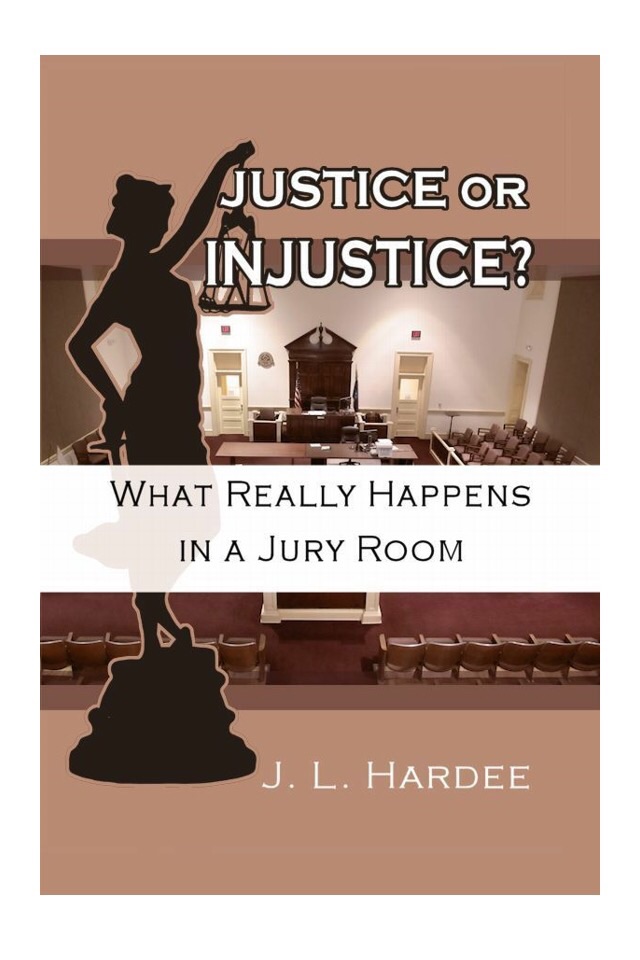 A week ago, I finished reading Justice or Injustice: What Really Happens in a Jury Room and it has some profound lessons for every trial attorney… Especially those in the criminal arena.
It is a short piece of non-fiction about a juror’s participation in a capital murder case and outlines the dangers that can occur when jurors do not know their right to hang a jury and hold onto their heartfelt and honest opinion on a just verdict. Compromise while expedient is not necessarily fair and just. Jurors are under tremendous pressure and really need help and guidance in understanding the process and their rights.
A juror has an absolute right to disagree, hold-out and hang a jury if necessary to serve the ends of justice. If this is not explained, then an innocent citizen on trial could end up on the wrong end of a coercive verdict. A group of jurors uncertain about their right to disagree eventually capitulated to the majority out of doubt and fear in the case of Kimberly Renee Poole. According to the author, the jury foreperson pushed the minority to change their verdict of “not guilty” primarily focusing on the character of the defendant’s background as a stripper and swinger claiming she deserved jail. Alone afraid, uncertain, tired, and nicotine deprived the last hold-out (the author J.L. Hardee’s) surrenders to a guilty verdict. After the trial, it is learned that the foreperson had a close ties to the prosecution which were not disclosed in voir dire. The holdout juror’s post verdict efforts to reverse what happened are discussed, but ultimately unsuccessful.
Although one was not given in the case, the story also demonstrates the danger of an Allen Charge or dynamite charge as it is sometimes referred to by the courts. See Allen v. United States, 164 U.S. 492 (1896). Such a charge is used to encourage jurors in the minority to reconsider their opinion.
Obligations and responsibilities as a juror include the following:
1. A jury’s factual decisions are forever. There is only one chance to get it right. Except in rare instances, appellate courts review legal rulings not factual findings.
2. Lady Justice is blindfolded for a reason. She is not influenced by station of life, background, color race, appearance, wealth, sex, religion or creed. Her protections are bestowed on every single citizen. Jurors are sworn to decide a case fairly and impartially without bias prejudice. If someone tries to decide the case based upon something other than the judge’s instructions and the evidence relevant to those legal issues, then they should be reported to the court immediately.
3. While jurors should not be afraid to honestly reconsider their opinion during deliberations, they are fully within their right to disagree with their fellow jurors. No one will punish a juror for doing so.
4. While this may be the most difficult thing a person is asked to do, they must be strong and courageous if justice is to prevail. A person’s fate is in their hands.
The Right to Trial by Jury – Power to the People
 There is no greater check on the power of government, large corporations, or the wealthy and powerful than a jury of everyday people from every walk of life. A jury consists of a cross-section of the community. A juror typically serves once in a lifetime. A juror isn’t there to run for re-election. They are not for sale to the highest bidder. They are the conscious of the community.
Here, we will discuss the origins of this precious right. We will look at the systematic assault on the right to trial by jury by those in power and with influence. We will look at in some instances actions taken by our courts and legislatures that have weakened this protection. We will also take a look at current and past jury trials. I welcome your comments.
 The Right to Trial by Jury